

Ben Wiseman
Ben is best known for his clever, incisive, and boundary-pushing editorial work, which has been featured regularly in the New York Times, the New Yorker, the Wall Street Journal and numerous other publications, not to mention in many commercial projects. We sat down with Ben at his Connecticut studio to chat about the changing landscape of media, the thrill of editorial illustrating, and how he starts his process…
1. How long have you been an artist?
Professionally illustrating and working on my own since 2009, but drawing and attuned to design for as long as I can remember.
2. How has the industry changed in that time?
I graduated from Parsons a year after the iPhone was released and since then it’s been the steady rise of screens. My career really feels like it’s gone from grayscale to CMYK to RGB. When I was starting my career, one of the points of entry for illustrating for The New York Times was their letters section. The illustrations would be smaller than 2’’ x 3’’ and black and white only. Now that seems as ancient as the rule from college about designing a logo so that it’s still legible when faxed.
3. Do you ever miss the simplicity of working in greyscale, or is that simplicity a misconception?
No I wouldn’t say I miss it. But limitations can be helpful and I’m still drawn to limited palettes.
4. How much of what you make now lives permanently in the digital space, as opposed to print media? Do you miss print media?
I feel like most things still have some print component, but the work I currently do for The New York Times is primarily digital—and I do miss seeing it in print. I love print media and still get tons of magazines delivered.
5. Tell us about your workspace, where do you do most of your work?
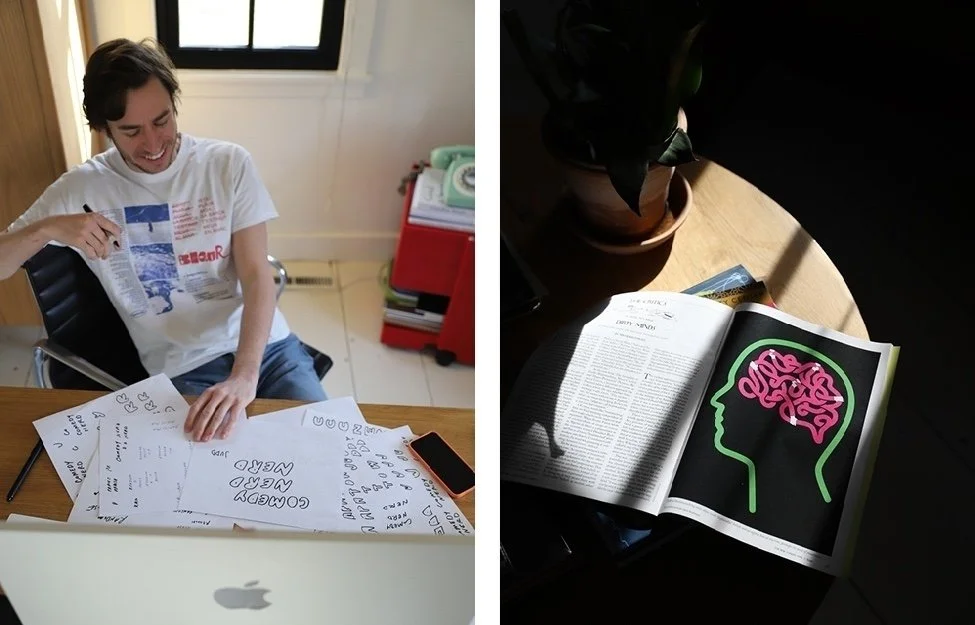
I have a studio within my home in Litchfield County, CT. It also functions as my library, and I love being surrounded by all my books, especially my art and design books which are great sources of inspiration.
6. What are your biggest inspirations right now? Art, design, or otherwise?
I’m working on a theater poster for a show set in the 80s, so I’ve been looking at a lot of retro magazines which has been fun.
And I’m always going to as many museums as I can. The Siena show at the Met was great and the Alvin Ailey show at the Whitney was very inspiring.
7. Are there things besides your books that you like to keep in your workspace? What kinds of art supplies?
Tons of pens and pencils that I cycle through. My Wacom tablet is essential!
8. What's your process like when you start an assignment?
Reading and thinking. Reading the brief or the article a few times to really see what themes stand out to me is key. From there it’s a lot of thinking and doodling. I often find that my best ideas are usually my first – or the ones I come up with an hour before sketches are due. But my sketch process is always about coming up with as many ideas as I can and trying to push each to be better than the last until I run out of time.
9. You have an extensive body of editorial work, have there been any projects that have meant more to you than others?
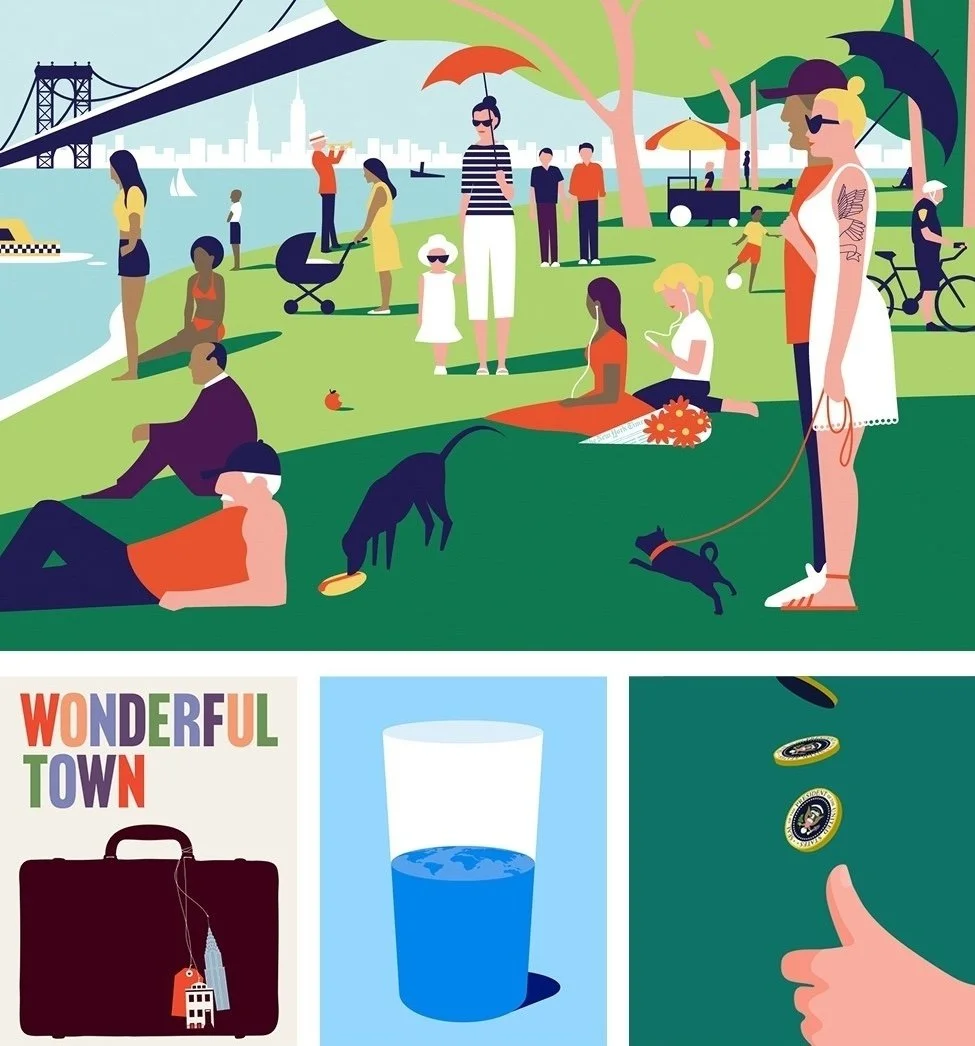
One I’m really proud of is illustrating Patrick Radden Keefe’s original piece in The New Yorker that exposed the Sackler family’s role in the opioid crisis.
Two others that come to mind involve the Supreme Court for The New York Times. Both instances involved rapid fire-turn arounds, as these columns were responding to breaking news. In June 2015, the Supreme Court ruled in Obergefell v. Hodges that the right to marry is guaranteed to same-sex couples. And in May 2022, the Supreme Court overturned Roe v. Wade. To me, both show the challenge and privilege of working editorially—how do I work on topics that inspire me or enrage me and how do I do it quickly? Today, the image of hope in my 2015 illustration definitely feels jarring, while the menace in the 2022 illustration, unfortunately, still feels very present.
10. I remember that New Yorker article and the buzz it caused. Has there ever been a piece (that you were working on) that made your jaw drop when you'd initially read it?
I’ve had several that were really illuminating. I remember a piece from The New Yorker about corruption and exploitation in hospice care that was shocking. And a cover for the NRDC where they ranked the environmental impact of the big brands of toilet paper--definitely made me look differently at that aisle in the grocery store.
11. Are there ever times that working editorially feels too stressful because of the politics involved?
Yes, it can be overwhelming, but I also know how lucky I am to do this as my job. I felt fatigued from illustrating Trump and his politics by November 2016, and that was just the beginning. So I try to take what can feel exhausting and turn it into a challenge—how can I show this in a new way?
12. Is there anything about your work, process, or career that you wish people knew?
I like working on lighter and fun topics too!
13. Your designs for "Urinetown" and "Wonderful Town" were awesome. What do you enjoy about designing theater posters?
I’ve loved theater for as long as I can remember. As a kid growing up in Kentucky, looking at Broadway posters felt like the closest I could get to those shows. It really was my first awareness of design and illustration and their power. To work on them now is really a dream job.
14. Do you have any other dream gigs, or projects that you'd love to do?
I’d love to do a title sequence for a film or tv show.
15. Thank you for speaking with us! Any parting words?
Thank you for the great questions!