

Ian Dingman
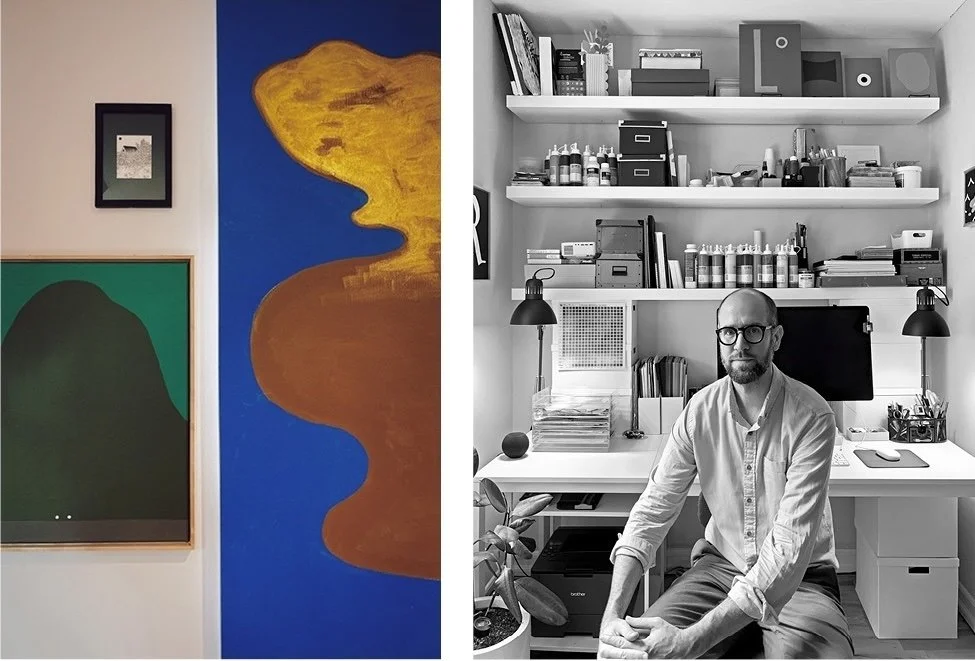
Ian’s work has been commissioned by The Criterion Collection, The New York Times, The Boston Globe and Merge Records, among others. Ian is also an Art Director at Penguin Random House. He spoke to us from his studio in NYC…
1. Where did you grow up and how did you get into making visual art?
I grew up in rural Illinois and cannot remember a time when I wasn’t making visual art of some kind. Growing up in the 80’s I was heavily influenced by pop culture, video games, and sports. I would draw new characters for my favorite cartoons, I would draw new maps and worlds for my favorite video games, and I would draw fictional players and fictional teams for my favorite trading cards. My parents were very supportive of my creative interests and enrolled me in classes and camps, most focused on traditional mediums. Graphic design was influencing the type of fine art I was drawn to, so I was accidentally creating modern graphic art with traditional tools, and I think it was confusing for my teachers and supporters to see landscape paintings that you couldn’t really define as a traditional landscape painting.
2. When/how did you make the transition to professional illustration?
I couldn’t decide on a specific discipline in college but I was interested in the intersection of art and computers. So my first job after graduating was a graphic design role at a small publishing company in Chicago. I loved the work and really started to explore typography. I was spending a lot of time during the day at a computer desk, and time in the evenings at a drawing table. I was building two portfolios of work at the same time, and my interest in narrative editorial illustration began to overtake my graphic design interests. Finally I made the leap and went from full-time graphic designer to full-time freelance illustrator … and worked professionally for five years exploring every vehicle I could find: posters, magazines, album art, dvd art, books, wine labels, packaging, novelty gifts, interactive flash animations, and so on. I went back to publishing in a full-time job, but never left the collaborative freelance mindset.
3. What was it like transitioning into art direction? Did your work in illustration make it easier, or was it a totally different skill set?
I learned a great deal from the art directors I worked with early on in my career. Taking direction and seeing what I could do created conversations in problem solving that always seemed to elevate the projects. Collaborating with fellow designers and illustrators is always very exciting to me. Receiving sketches can be as exciting as opening a gift, and sending sketches to a client is gift-giving, in a way. But it’s fun and challenging to be on both sides of this equation. There are so many solutions to the projects I’m drawn to that it somehow eases the pressure of doing things the right way, the best way, or the only way.
4. What are your favorite subjects to illustrate/ favorite jobs to take on?
I like the conceptual, problem-solving nature of illustration. A headline in an article can inspire a hundred different solutions. The title of a record can spark endless directions to choose from. The shape of a box for a packaging project can offer three-dimensional solutions. My favorite subjects are often people, places, things … and architecture. There’s something about order and line that speaks to me, and I like to think that my work has a certain architecture to it by way of composition and character.
5. Where do you find inspiration? What's inspiring you right now?
I find inspiration from being out in the world with my eyes open, looking up, looking down, taking photos, and jotting down in-the-moment thoughts. Architecture, geometry, symmetry, symbology are all an endless source of inspiration. Poetry is another great source of inspiration. The action of drawing mindlessly while listening to music drives my motivation to continue to be inspired.
6. The intersection of art and technology is always fascinating. Is your computer your preferred artistic medium? Which others do you enjoy?
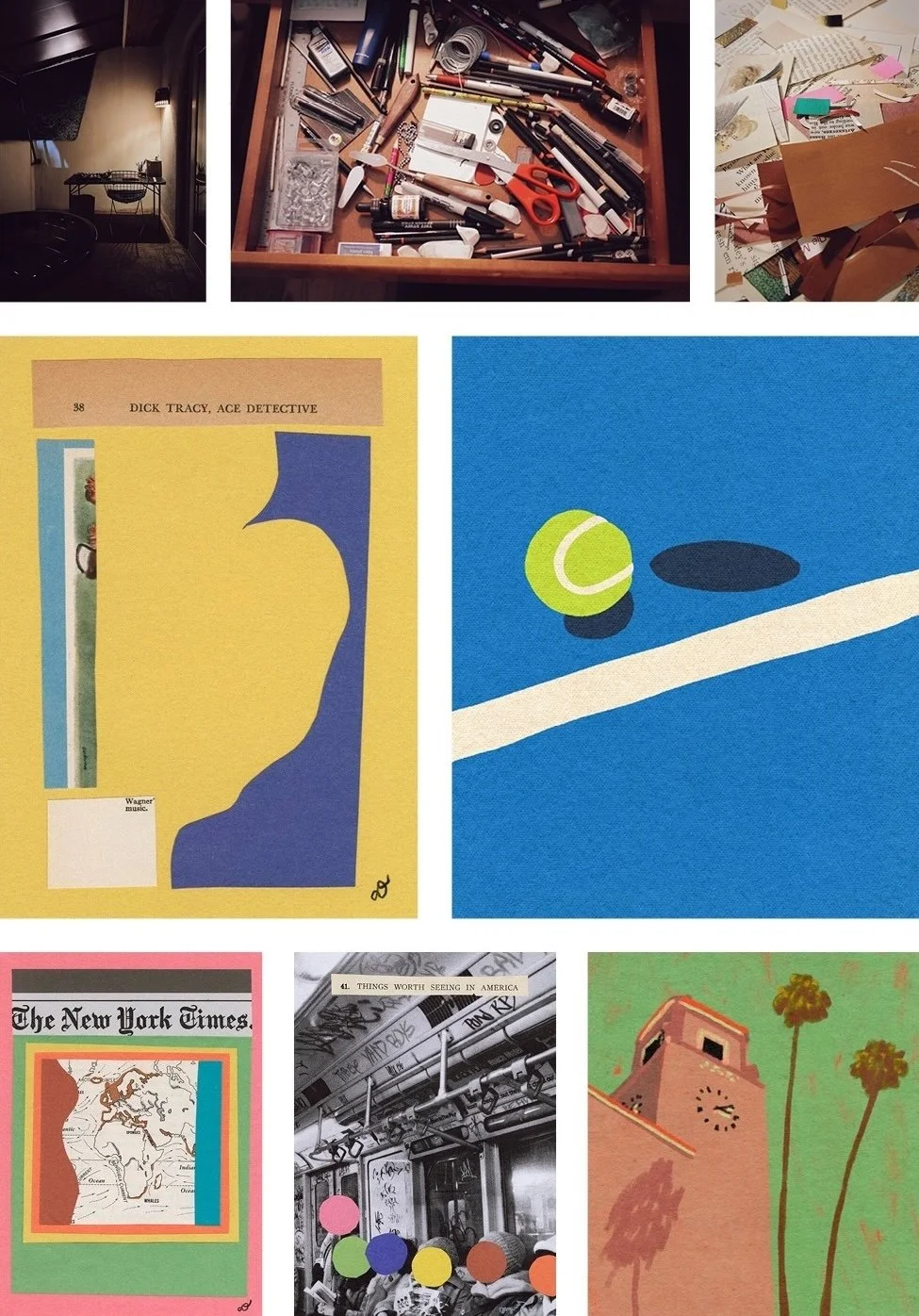
I love digital work as much as analog, and feel like they’re both satisfying in their own ways. The tactile nature of analog work feels special and I appreciate the limitations that come with it. Digital is a little more unruly and I’m sometimes intimidated by the endless possibilities working digitally can bring. Overall, I try to keep a balance between the two and, more often than not, both styles of work are being integrated into the pieces I’m making.
7. You've created some very well known imagery for films as well as designs for books and albums. Aside from watching the film, reading the book, etc, what are your first steps in creating an illustration/design for film, album, or novel?
With every project I like to familiarize myself with the material in a cautious way. I work quickly at the beginning to give my gut a chance to react without too much influence. After getting some initial ideas and sketches down, I’ll dig a little deeper into the material to see if there’s more to explore. I’ll then put the project aside for a minute (if I have a minute) and return to it with fresh eyes. For me, this step is important because I like to follow my instincts but understand that my initial thoughts aren’t always the best direction to take the project. Authenticity is important too so, no matter what direction the project takes, I do my best to take the time I can to be authentic to the material.
8. Speaking of your architectural work, a fellow illustrator/designer named Justin Mezzel wrote in his blog, "Ian's capacity for bringing human levels of emotion into inanimate objects is next to none. His architectural pieces feel anthropomorphized in the same world that his characters populate. It's easy to think of his houses as living, breathing people with a story to tell." What is it about your approach to architectural illustration that gives your pieces so much life?
That is an interesting and flattering quote! I’ve always felt that architecture has a strong emotional pull, whether we realize it or not. The amount of detail to include or omit in these types of pieces can be similar to considering how much information is given to the reader when developing characters. As far as technical skill, I can draw a straight line but my hand is a little shaky, and that unevenness builds character. I sometimes use rapidograph pens for architectural line work and the tips are so fine that they make micro-tears into the paper, which interacts with ink in a way that is somewhat out of my control, and I think that also brings a character quality to it.
9. Tell us about your work space, where do you like to create your work?
I currently have a room at home where I’ve carved out a little space for myself to work when I need to be focused and have minimal distraction. But I love to work wherever I am: from the couch, dining table, train, airplane, and I find these spaces help me approach the work in a less formal way than sitting at a desk. But I also love a huge desk or table where I can spread out. There have been times in my life where I have felt like I needed a large studio space to create larger than life pieces, and there have been times where I feel like all I need is a table, chair, and letter-sized paper. If I’m inclined to work digitally, I have an ipad. Lately I’ve been incorporating physical collage elements into my work and am still figuring out how best to approach this kind of work without making an enormous mess. Somewhat recently, I spent a month in New Mexico, working from a patio with just a folding table. It was a good reminder that I don’t need much to do meaningful work.
10. What are a few things you have to have in your work space?
Art supplies are one of the few things that I’m not a minimalist about. I probably use only 1% of what I own, but there is something very liberating about having an arsenal of tools nearby should the mood strike. Ambience-wise, I’m always listening or half-watching something while I work. I also like to keep the windows open for sounds of life.
11. What does a typical work day look like for you?
I’ve had many different routines throughout my life and the only constant is that I like to work at night. Mornings and afternoons are good for email, meetings, and housekeeping. But when it comes to making work that feels the most creative and successful to me, it’s definitely after noon and often late into the night.
12. Do you have any dream jobs, or clients?
I would love the opportunity to paint a mural - or something environmental, like a stage backdrop or hand-painted signage.
13. Thank you for your thoughtful answers and welcome to the ID family! Any parting words?
Of course, thank you for the great questions. I’m excited to be part of this amazing group of like-minded artists.