

RF. Alvarez
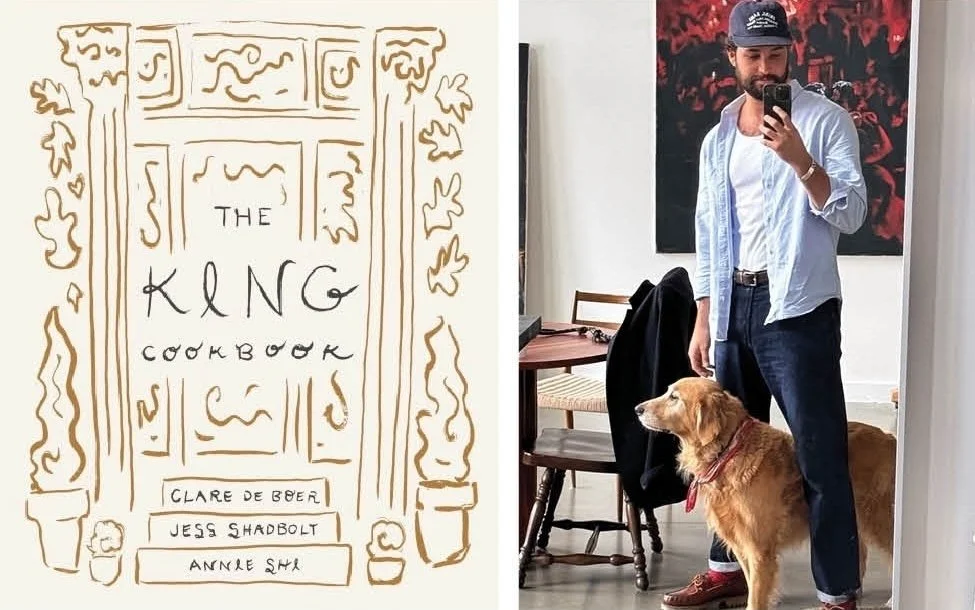
RF. is an illustrator and fine artist whose work captures tender intimacy and raw emotion with a deep, lush color palette, set mostly against a Texas backdrop. His commercial clients include Bon Appetit, The New York Times, King Restaurant and Vintage Books. And we’re kicking off 2026 with a meeting at his studio in Austin, TX.
1. When/How did you discover your love of art?
I've always been making things, since as early as I can remember, sort of out of necessity. And I wonder if my love of visual arts really just stemmed from a giddy realization that there exists a whole world of other people who make things, too. People who have to get what's in their guts out into the world. And those people study the guts and discuss it, are moved by it, and… how wonderful.
I remember the first time I saw Monet's lily pads. That struck me down to the ground and I think I was maybe seven. I grew up watercoloring with my great grandmother, too, and she taught me how to see things. My dad loves art and travel and took me to Florence when I was maybe 11 or 12? Old enough to know who Boticelli was and young enough to admit it willingly.
2. How did you make the transition to professional artist/illustrator?
Piece by piece. I didn't get a BFA, my parents didn't finish college, and it sort of wasn't really an option to be an artist. They loved my creativity, I enjoyed expressing things, but it was a hobby, an outlet. So I pursued the closest thing I could find: graphic design. And I did that for almost ten years, ran my own design consultancy, painted on the side. I started selling my artworks through a platform called Uprise Art – an amazing asset for an early career artist by the way – and one day I made enough money off of the painting that I could see a way into it. And then the pandemic hit and I jumped at the opportunity to have a captive audience and I threw it all out there and flooded everyone with social media and sort of never looked back. I'm really grateful it took that long because, along the way, I learned not only how to run a business and take care of myself but also who I am, as a person (I met my husband in that time) and as an artist (I took the time to play and make and make and make until I got away from what I thought people wanted and started painting my guts).
3. What are your preferred mediums and why?
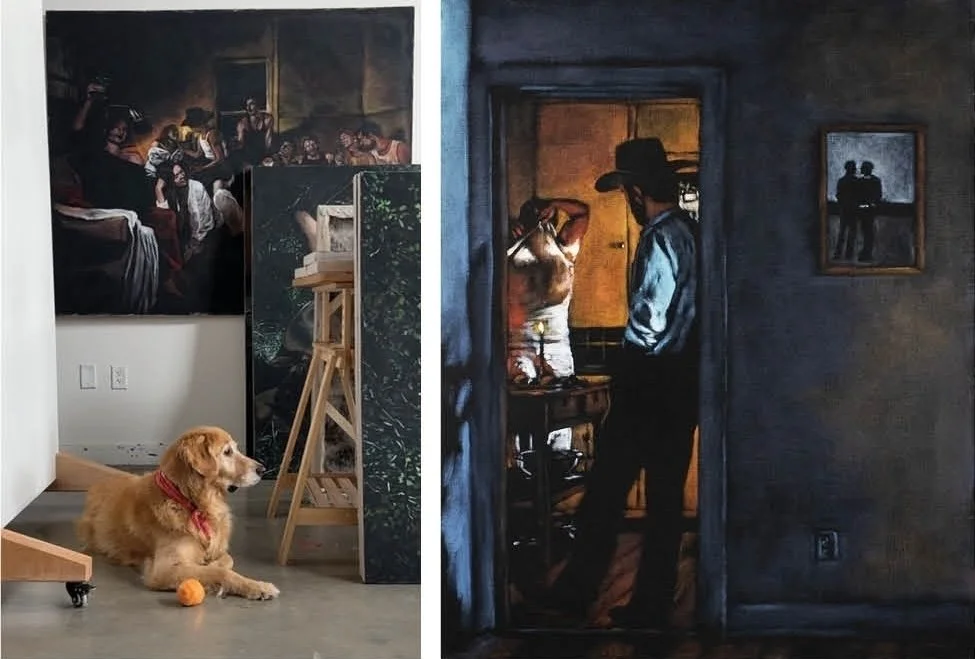
I paint. God I love a good charcoal, but I paint. I work in acrylic, because I paint directly onto raw linen and the paint soaks into the fibers in a way that sort of pixelates the image. I scrub. It's a blast.
4. How did you develop your unique style?
The work led me there. In my experience, a style isn't created ahead of time, it's created on the road. I played around, I made ugly things, I took nuggets from one work and expanded them into another. Trial and error and asking questions: What if I don't prime the canvas? What if I switch to linen because it has more tooth? What if I start with a layer of black and paint in the light? And so on. And then one day it just ended up here and it suits what I'm trying to say.
5. How did growing up in San Antonio influence your work?
The Texas landscape in general is essential to my work. I am painting figures who, in their very existence, are in conflict with the history and terrain of this place. My grandfather was a cowboy. I was a gay kid from the suburbs. What does a heritage look like as it progresses through generations? Who gets to wear the cowboy hat? Who gets to call themselves”from here”? The weather blows through central Texas fast and hard and we sit on the precipice of the green to the east and the empty wild deserts to the west. There's a whole heritage here, a very American masculinity, that I think most of us – men and women alike – are reconciling with. I'm interested in showing, in contrast to the John Wayne’s and Clint Eastwood’s we know so well, cowboys – Texans – who are tender. Men who belong, men who embrace. I want to show that, despite the harsh winds, despite the cruel politics, there is softness here.
6. You're located in Austin now, how does Austin inspire you?
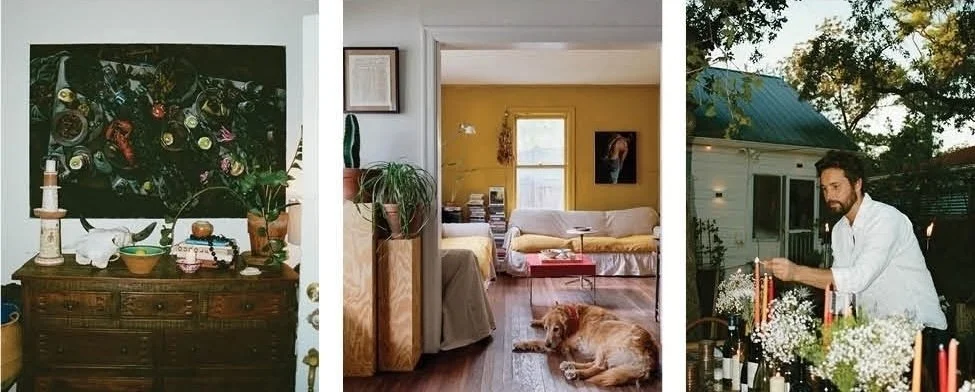
To paint is often a lonely act, and the only way to push back against the sheer embarrassment of putting your guts out there is to have a margarita in the yard with a group of people you love. I have love here.
7. What does a typical work day look like for you?
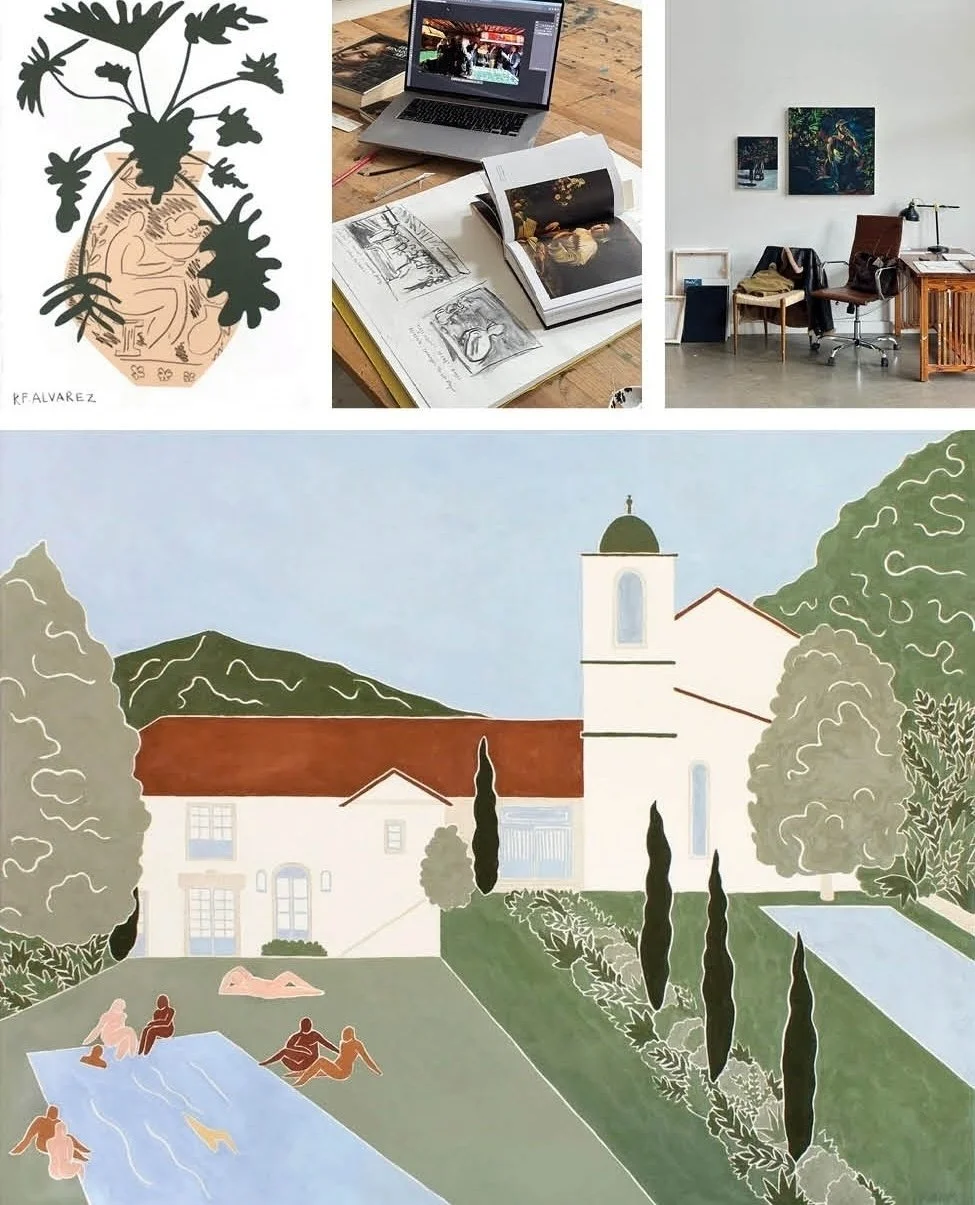
I wake up, feed the dog, and take him to my coffee shop where we sit for an hour or so while I journal and respond to emails and answer interview questions (hey) and have way too much coffee. He gets treats and pets. He's turning nine next week and we've been coming here since he was a pup. Then we go to the studio and I paint. I'm a big routine guy, I need to set some kind of structure or else I'd never finish anything. And I go home for lunch to make an omelette and my little french salad and then I go back and paint more, take meetings, cook dinner for my husband, and -- if I'm lucky -- have a margarita in the yard with good friends.
8. Your fine art seemed to reach a new level last year, at one point you had shows in both NYC and LA during the same month! What was that experience like for you?
Terribly exciting, a bit overwhelming, an absolute dream come true. I debuted I think 30 paintings all at once, across the two shows: a solo in Los Angeles at Megan Mulrooney Gallery and a solo booth at the Armory Fair with Martha's Gallery. It was sort of the fulfillment of these two lifelong dreams back to back.
9. With the recent focus on fine art, how has that influenced your illustration work and vice versa?
A lot of my illustration work has moved towards my painting, the cover for A Little Life being a great example. And the illustration work, which has always been much more loose and dependent on a confident line quality, has absolutely fed back into the fine art practice. I recently did a series of charcoal "rodeo sketches" that are a good example of something I want to do more – loosen up, trust my hand.
10. Speaking of which, your cover for the 10th anniversary edition of Hana Yanagihara's "A Little Life" is gorgeous. What was your process like for that particular piece?
It was probably the easiest illustration job I've ever done, both because of the trust that Hanya put in me and the clarity I had for the project. Hanya gave me sort of carte blanche, told me to paint a scene of my choosing from the book, and that was about it. No edits, no hard guidelines or specifications – she really set me free to do as I please. And I knew immediately I wanted to paint a scene from the very beginning of the book, something full of hope and connection. I love the book, and I always felt like the city itself was a character, fully deserving of focus.
11. What other kinds of illustration work would you love to do? Any dream clients?
I've done a restaurant, a novel, a hotel, a cookbook, editorial illustrations... my cup runneth over. But I think the one area I haven't had much chance to explore is high fashion. How fun would it be to paint a Hermes scarf? Or literally anything for Bottega? Louise! Call me!
12. What’s inspiring your work right now?
I think about Whitman's Calamus poems a lot. They were pulled out of Leaves of Grass for their overt homosexuality, and they're joyful and aching and absolutely beautiful. As for art, I could list the myriad of painters whose work I look at often and am deeply inspired by, but we'd be here all day. I'll throw out a few: Caravaggio, Hopper, Cadmus, Angus, Yiadom-Boakye, Sargent. And Film. Film!!! Film. I'm really really inspired by film. My painting work is often described as filmic; I look a lot at how cinematographers light scenes and faces. Hitchcock’s Vertigo is just as impactful to me as a Caravaggio.
13. What do you wish the people seeing it knew about you and your work?
I paint from a first person perspective and I'm a gay man and that means the work is innately queer but I don't think that's the point – or at least not the whole point. I'm interested in painting something broader about the human experience. I paint about how fleeting and beautiful this all is. How to find a place in this world, how to belong, for example, are central questions to the queer experience. But it's also central to most human experience. We are all, each of us, trying to understand where we fit in to all of this. And I'm very interested in the ways my experience can relate to someone who had a completely different upbringing or sense of self.
14. Tell us about your studio, any must-have’s?
It's light and airy and located in an industrial complex across the street from a coffee shop. It's great. I like to play some good classical music (Liszt, Schubert, Debussy, et al) and -- so sue me -- I light a scented candle. Lately I've been hooked on Figue 15 from Le Labo. Also, doffee is a must.
15. Thank you for taking the time to sit with us. Any parting words?
The work you and your team does to find clients, negotiate rates, advocate for artists, has been essential to my ability to creatively explore. Thank you.