

Tala Schlossberg
Tala is an American experimental artist known for her distinct animated style, original voice and inventive storytelling. Her animation practice merges rhythm, wordplay and systems of logic to construct entirely new ways of seeing. Schlossberg’s unique visual language—at once ironic, pastoral, and incisively original—reimagines the relationship between image, meaning, and motion. We had a chance to chat from her new workspace in Oregon…
1. Take us all the way back. When did you first fall in love with making art? What kinds of things did you like to create back then?
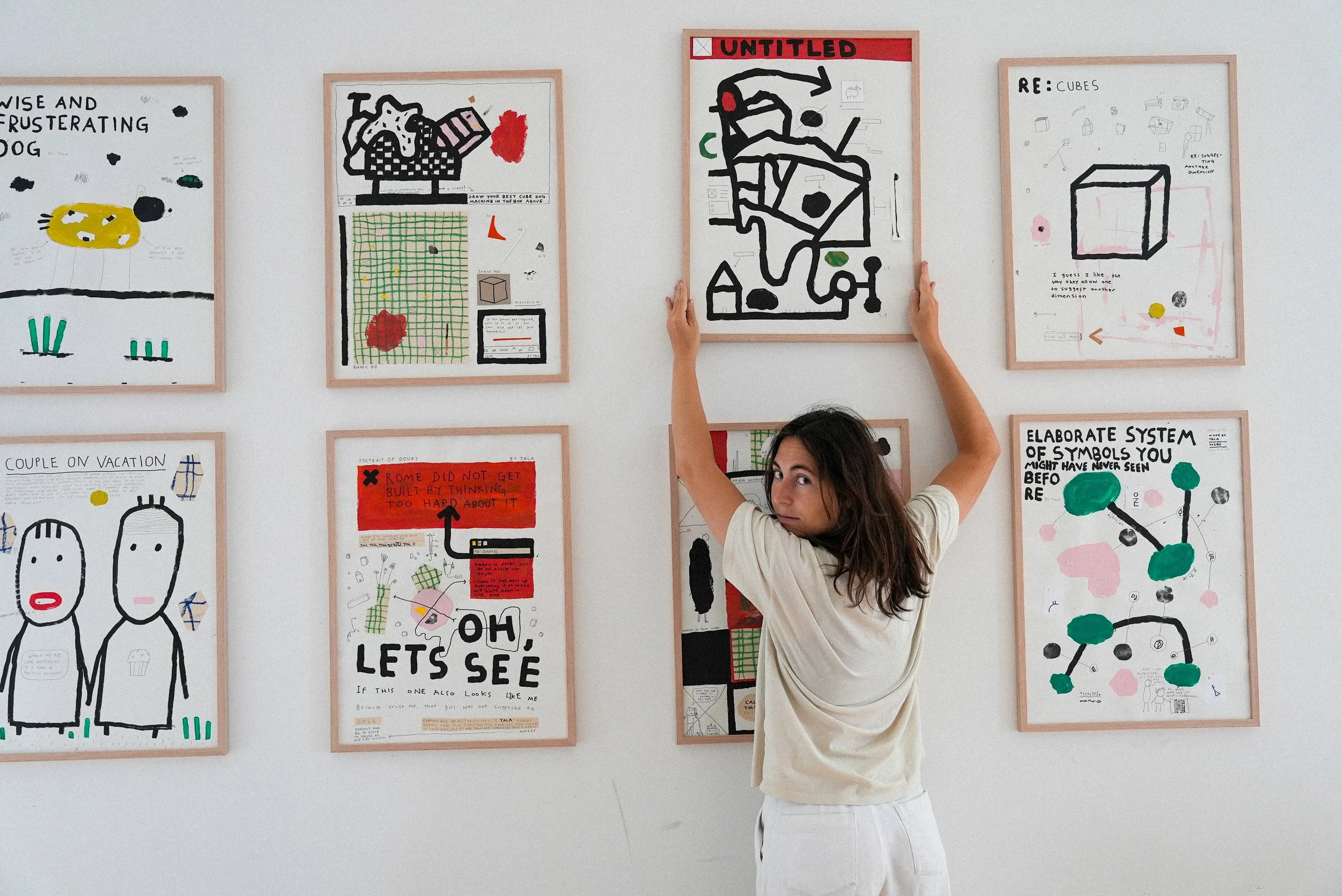
I’ve always loved making things. I have a book of poems from before I could write (dictated to my mother). That makes it sound like I was some kind of child prodigy but they were mostly about ladybugs and ghosts. I’ve always loved to draw. I’ve always loved to write. I’ve always been drawn to the stage. The art I'm doing now feels like a continuation of the conversation I've always been exploring - the absurd, the poetic, the divine and the totally human. Creating will always be my favorite thing to do. It’s my way of moving through the world.
2. Where did you grow up? How did it influence your work and how you see the world?
I grew up in Eugene, Oregon. I’m back in Oregon right now for the first time in a while and this question is a huge theme in my life. Growing up, I always had this feeling that I wanted to get out and move to the big city and travel the world. I’ve gotten to do a lot of that. And now I’m in a phase of reconnecting with home and realizing how many deeply kind and creative people made me who I am. Also the trees and the mountains and the connection to the earth and the seasons. I feel the most like myself when I’m drawing or playing outside.
3. When did you make the transition to professional illustrator?
I started taking on odd jobs in college - I went to a tiny liberal arts school called Quest University in British Columbia, Canada. There wasn’t a formal design program, so I started taking classes nearby on the weekends learning the Adobe suite. I began sharing the work I was making and people pretty quickly started asking me to create illustrated and animated work. I did all kinds of odd commissioned work while I was learning - I created the billboards for a mayoral campaign, designed a website for a nightclub, and got commissioned for my very first animated explainer for a hospital on the topic of irritable bowel syndrome. We have this cultural myth that you need to be in a big city to thrive creatively, but if you’re trying to actually learn, stretch yourself, and use your skills to uplift your community, small towns are where it’s at.
4. How has the industry changed since you started illustrating/animating professionally?
I’m still very young and operate somewhat outside of the industry (I worked at The New York Times, ran a creative studio, led retreats, and now work independently). So I’m not sure if I have quite enough perspective for an answer on that one. Social media feels like it’s changed the creative landscape in a major way. I feel really conflicted about it - it’s totally addictive and often problematic. AND it’s given me so much creative freedom and connected me with incredible artists and opportunities around the world.
5. How has your own style evolved?
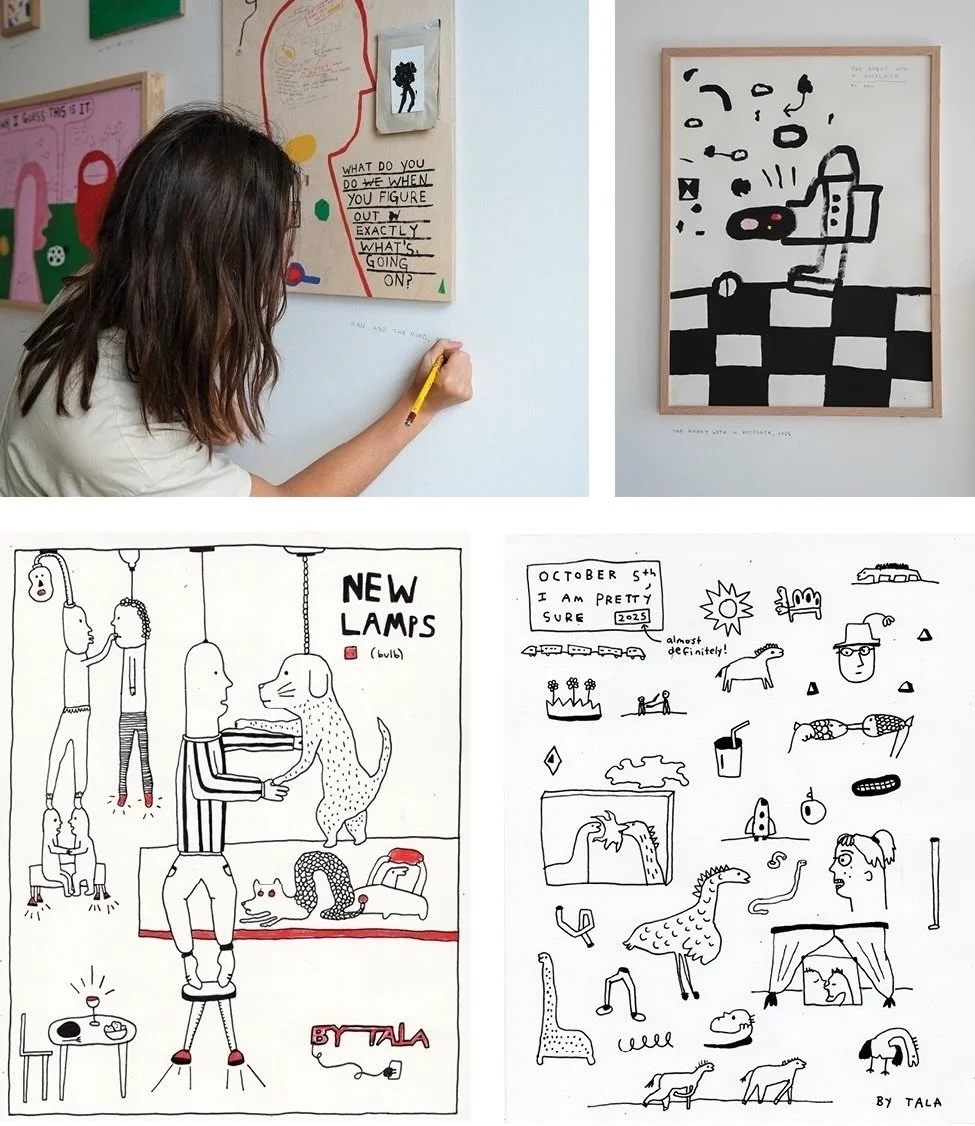
My style is always evolving. My style evolves with everything I learn – I am always trying to find ways to incorporate new technical skills into the work I'm creating. In order to stay inspired, I have to be improving in some kind of way. My most recent style evolutions are the color orange, vocal harmonies and film footage (I just got my first super 8 camera). I work cyclically, meaning I am in constant rotation between medium, perspective, level of sensitivity, and collaborative relationship with the world around me. All these levers are being adjusted all the time and the work is what gets squeezed through the whole system.
6. When did you start experimenting with animation? What attracts you to animation?
The summer after my second year of college, I took an intro to animation class while back home in Eugene. It totally changed my life – I’ve always loved math and problem solving and logic. And I’ve always loved to make art and tell stories. Animation felt like it perfectly connected both sides of my brain. Animation has opened up my whole life. To have the tools at my fingertips to create whatever imaginary reality I want… that’s an unbelievable amount of freedom. I feel that animation is a medium that glues all the things I love to each other.
7. Your expansive portfolio contains video essays, video art, experimental animations, projections, collage, zines, projections, and even sign making. What provokes you to stay in such a constant state of experimentation and what has it taught you?
If I am not creating from a place of authentic exploration, I am very unhappy. There’s simply no other way around it.
8. You spent a lot of time in New York City, what about the city inspires you?
New York City is the best. I love New York. It’s an enormous amount of energy crammed into basically a seaside town. Like, it smells like salt some days and huge storms roll in off the ocean. I’m inspired by the way that a place can be so urban and yet filled with nature. People always ask me if it was hard to move from the West. It was hard, because nature is not as obvious in the city. But when you learn to see it, New York is just pulsing with it everywhere. New York City is completely alive.
9. What else has been inspiring you lately?
In general, I’m totally enamored by place. I’ve been spending time in the desert this fall. The desert is magical and totally bizarre. Everything is uniquely shaped. Tons of little treasures, everywhere. The desert makes me feel wild and free.
Music is crucial to my life. It mirrors my creative phases. I feel that I can understand my place in the world through music. Generally I rotate between weird british pop, electronic disco type songs and women with lovely voices. I like creating unique combinations between songs and places.
Also I am currently reading a manuscript written by my neighbor in the desert. It is a memoir about horses and it is wonderful.
10. Where do you usually work?
I work everywhere. Seriously everywhere. I work at a desk, in a studio, in the car, in bed, at the gym, while walking around. I think of my time I spend at the computer as about 10-40% of the work I do. There’s a great deal of time in the day that must be allocated to thinking and “visualizing” I like to call it. This is basically laying on the floor with my eyes closed and playing scenes in my imagination. Experiencing the world is working. Hanging out with my friends is working. All these things that help me to be more perceptive and sensitive are what really make the work. The computer and the pen and even the paint come last. I like to have the idea ready to go before I hit the page. This is not always possible, but it is certainly aspirational. It is important to me to be able to stay locationally versatile.
11. What kinds of things (tools, books, toys, etc) do you have to have in your work space?
My essentials: computer, notebook, black pen, black sharpie, camera, microphone, headphones, tripod, 2 hard drives, a red crayon and my ipad. Lately I’ve been into loose leaf paper, a clipboard and my blue light glasses. These are add ons though.
12. What does a typical work day look like for you?
I actually made a video about this! There are a lot of different kinds of work days I have (There are about 4 different types of “days” I have found that I like to rotate between). But the day in the video is my favorite kind.
Watch: Leaving Home
13. What have been some of your favorite collaborations/commissions so far?
I love musical commissions – I did a few animated projects in the past year where I was basically given a song to totally run with (An electronic dance hit, a jazz album, the festival visuals for a pop star). I don’t work well with a lot of revisions or early stage notes. I like the space to find my own inspiration and then run with the idea. I find it makes the best work. I collaborated with Herman Miller to design their holiday campaign this year. That was a really fun project – they are such lovely and smart people. I also really enjoy editorial work. Having worked at The New York Times, I have a certain affinity for the pace (fast) and the big picture thinking that editorial work requires. I’ve also been getting quite a few fashion commissions lately. This has felt odd to me because I do not own anything fancy at all. I’m very down to Earth. But fashion is art, so art for fashion is really art for art, so there’s quite a lot of room for making beautiful things in this space.
14. Any dream commissions or collaborations?
I love music, I love installations where people can interact with art. I love collaborating with other creative people. I find such a sense of belonging when I get to work alongside other people who really care about what they are doing. I love interpretive commissions, where I get to authentically react to a song or a prompt of some kind. My creative strength is that I can explore very widely and think way outside the box. So I like projects that want me to use that part of myself. I like it when people genuinely want me to surprise them. I am always looking for creative territory that feels weird and new.