

Joanna Neborsky
Not every illustrator has an aesthetic as immediately recognizable – and unforgettable – as Joanna Neborsky. Her style has been likened to “Shel Silverstein meets Yellow Submarine meets Cy Twombly”, and that’s really just a glimpse of the wry, literary spirit coursing through her extensive body of work. Whether it’s fever dream collages for books and editorial projects, or the inky, liberated hand-drawings seen in her animation and fashion work – or a magical blend of all of the above! – Joanna’s art vibrates with storytelling, humor, and dynamic motion. We had the pleasure of a chat from her LA studio...
1. Tell us a little bit of your origin story. How did you break into illustration, and what has kept you here?
In 2006, I went to a talk by Maira Kalman at Parson's. The entire crowd was doodling. I was doodling. I was like, Are these my people? Maira called herself an illustrator-author, a hyphenate that was new to me. It seemed to join disparate parts of myself (the art person and the word person). I did a bit of research and applied to the graduate illustration program at SVA. Where–nice punctuation mark–Maira Kalman became my thesis advisor.
Fifteen years later, I feel lucky that my job is like kindergarten. Like, my job is crayons. E-mails too, but largely it’s crayons and scissors and glue sticks. I am very, very lucky to indulge in childlike creation and silliness per request. I do wish it involved saying the occasional hello to a person, in person. When you complete a project, there’s no high-fives or drinks at the bar; you send in the finals, and it’s like, I guess I’ll stand up and walk in a circle.
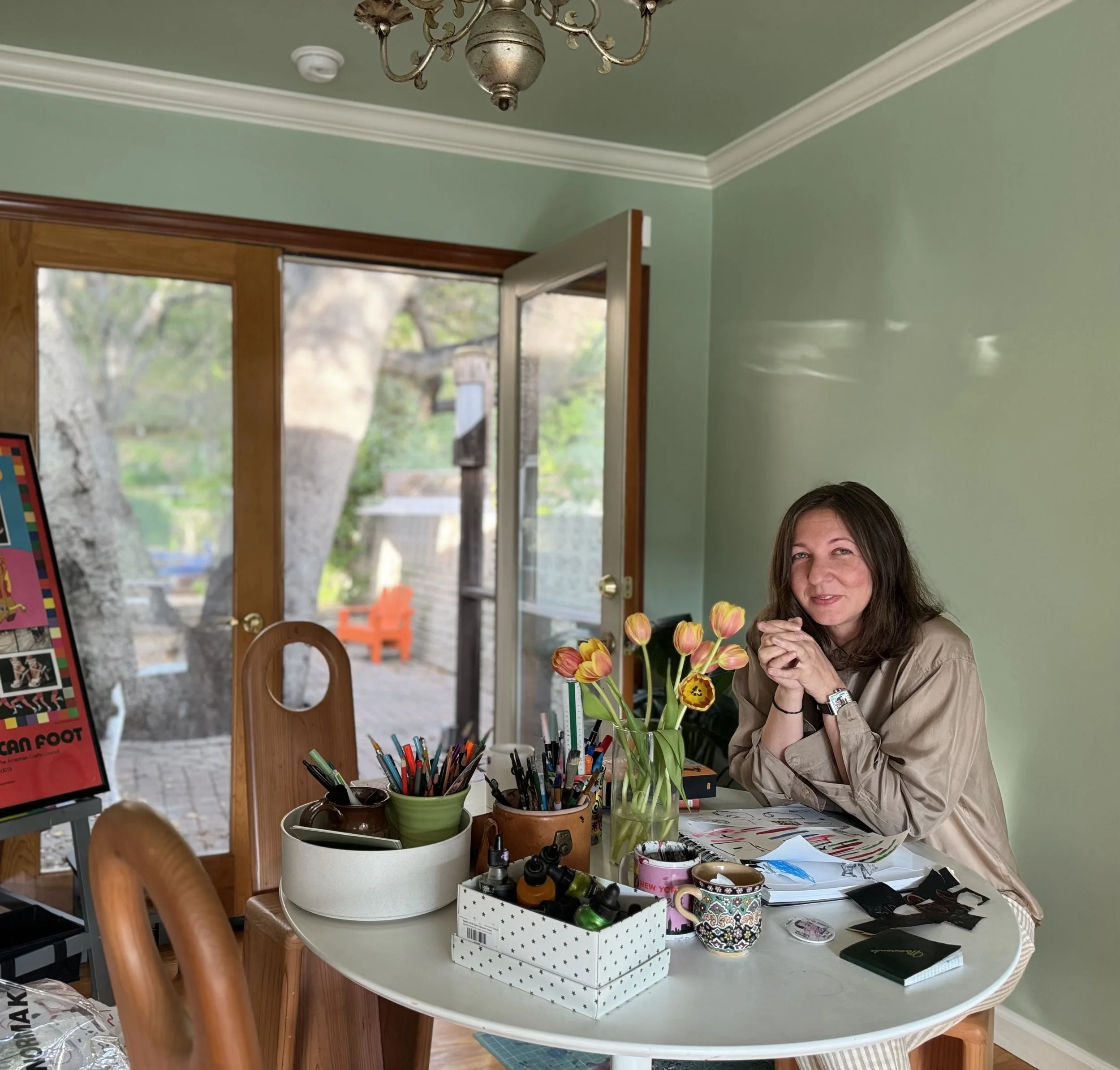
2. East Coasters wanna know – how's the Los Angeles life? What's your physical space like for your work?
When I’m not walking the red carpet, hot-rodding down the LA River, or drinking collagen smoothies, I live in Glendale. There’s a romantic myth that attaches to Los Angeles (the light, the vastness, the weirdos) that I subscribe to about half the time. The other half, I’m taking 10 minutes to re-park at the UPS Store. But you have the mountains and the beach to sustain you.
When I moved houses last year, I unpacked my studio and library into a very masculine garage designed by and for a car guy. It’s like 700 slick gray cabinets, a tad depressing for my kind of work. So, despite the photos we’ve artfully staged for this newsletter, I work in bed and on the coffee table. It’s a chaotic blur of art and life. Supplies wander. I’ll find a cutout of a child on my child.
3. How do you approach your collage art vs your hand-drawn work?
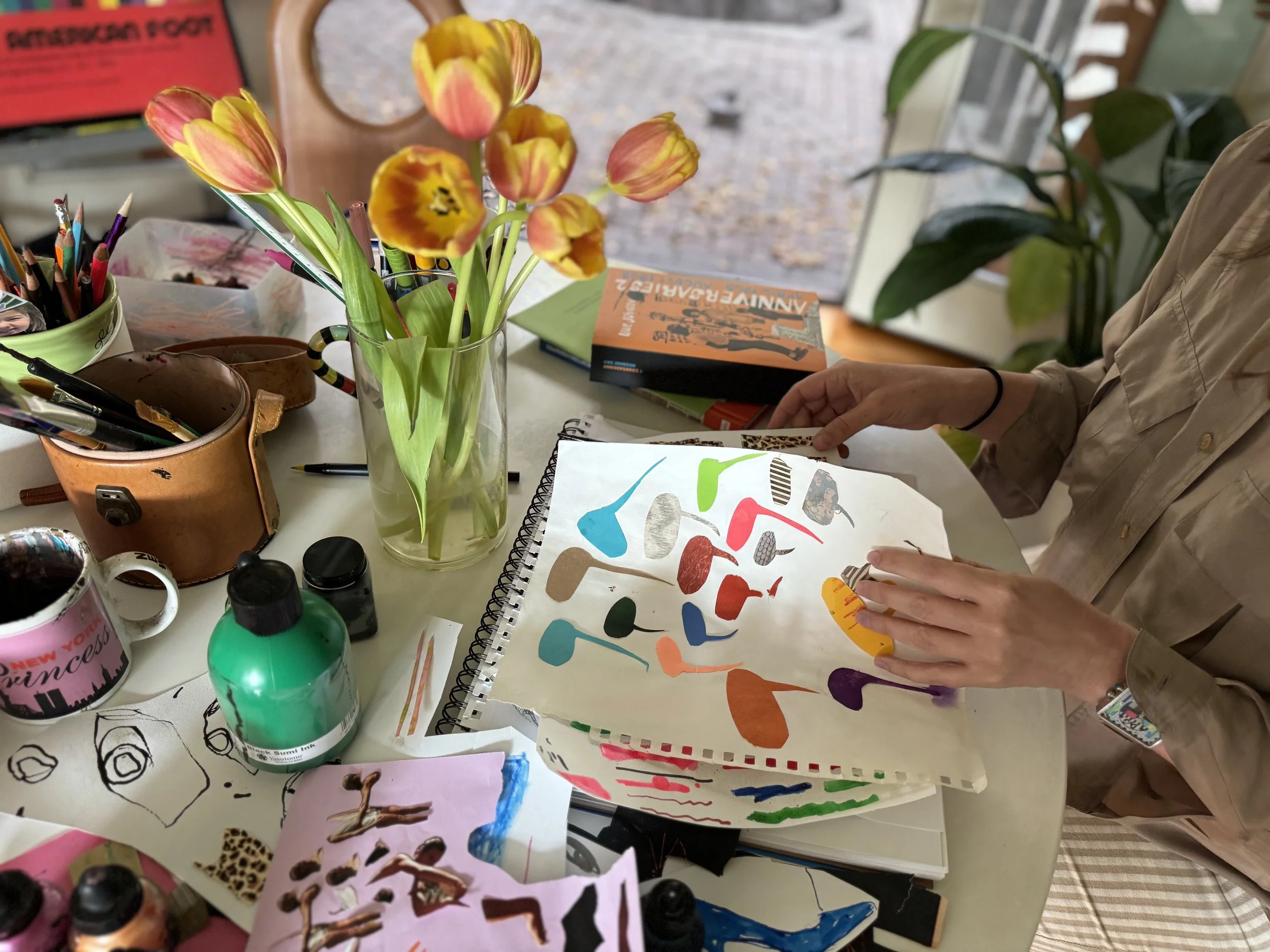
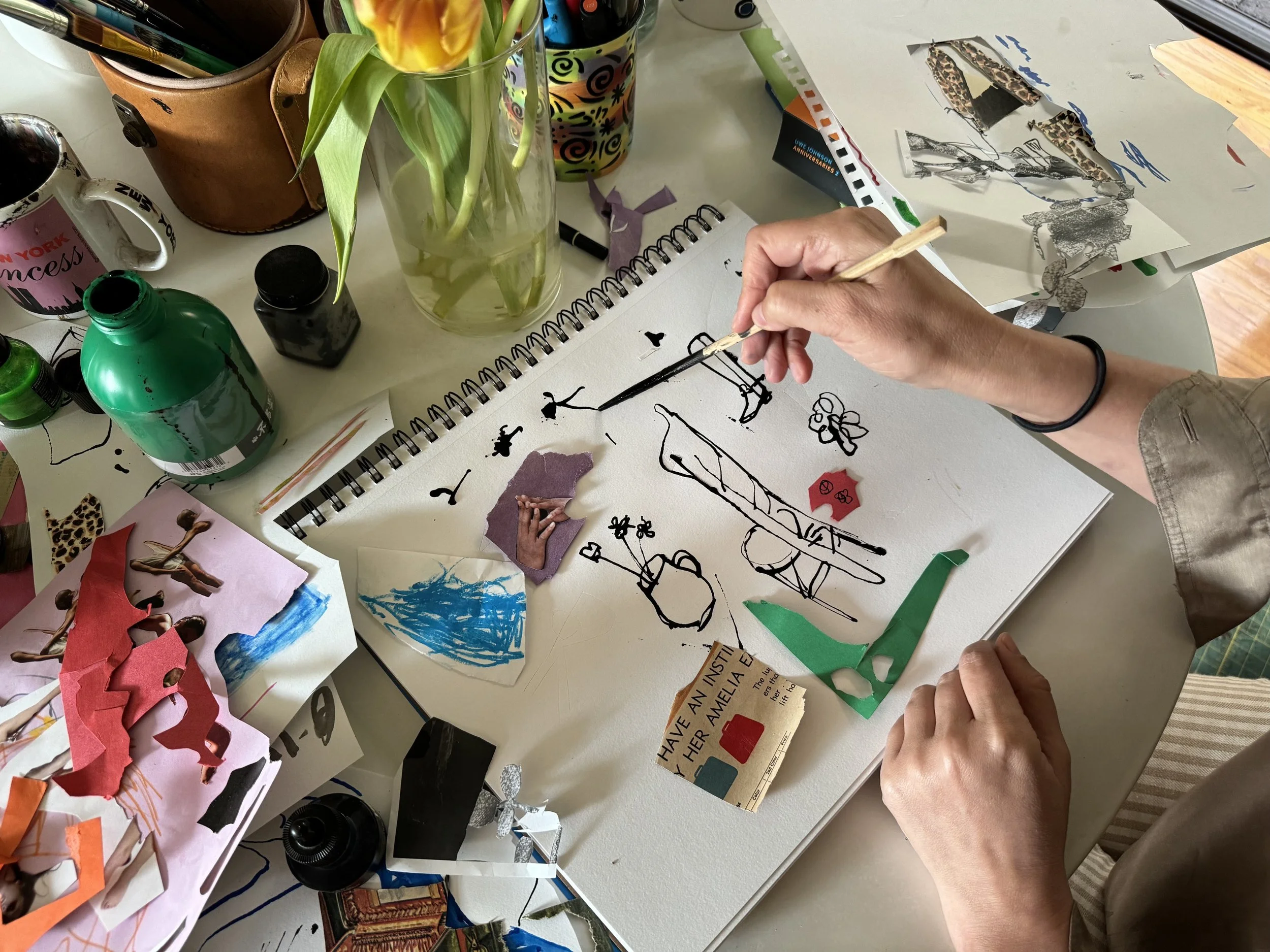
I identify the theme of the story and raid my rather large collection of photo cutouts, spanning historical eras, animals, buildings, machinery, foods, for fragments that could suggest the subject at hand. Or, if I know I’m unlikely to have the right thing, I head to the blessed LA library. I set the cutouts next to one other on my screen to see if a relationship emerges. Then I draw or cut and paste the missing incidentals or accents to round out the scene.
I think people mostly come to me for the cut n paste; I’m surprised and pleased when they ask for drawings. I make my drawings with sticks dipped in Sumi ink. It’s important that you get the “Sumi”; I once said Sumo in an interview and it’s haunted me ever since.
4. In addition to illustration, you've taken the helm in animation and have authored a number of books: A Proust Questionnaire, Some Assembly Required, Tumbling Old Women, and At Home with H.P. Lovecraft, to name a few! Yours is obviously a storyteller's brain. Can you describe how you craft narratives in your craft?
I seesaw between acts of collection (of cultural detritus and paper scraps) and subtraction. Then combine them with my messy drawing hand and generalized messiness. Sometimes things fall on things and that ends up on the page, or being the page. You learn to follow and permit your accidents. The last few years I taught illustration at Otis College. Between too many “share screen” accidents to recount, I was always encouraging the students to illustrate diagonally to the stories. Do this and you should be fine.
5. What is your ideal way of working with clients?
When they like what I do and they just say, “Go.” But I also enjoy when a client is a bit more specific and throws up parameters, especially when there isn’t time to deeply misfire.
When New York Review Books came calling to do a book cover–and not just any book cover! three covers for a mammoth box set, a new translation of Uwe Johnson’s 1700-page Anniversaries –I was tremendously moved. I was living at my dad’s house during a rough period and it could not have seemed a more unlikely and miraculous offer. Oh, and when one of the Johns from They Might Be Giants wrote to me to do a music video and asked me to draw dogs that were “rough and itchy, unruly, pandering, sleepy, persistent, distracted, manic.” A dream. Matt Dorfman from the NYT Book Review has stayed in my corner for many years and always makes me laugh with his grave silliness, and patiently nudges me toward better pix.
I do love the fashion jobs. The Kate Spade book [It’s So You: The Joy of Personal Style, released by Abrams in 2023] was super-fun for me. Citrine mules and shimmering socklets! More, please.
6. Who, or what, are some of your inspirations?
This is where I start to panic….I can’t choose! I read a lot of children’s books these days. I give a big orange medal to The Big Orange Splot. Chunky, perfect drawings of houses and people, and the main character, Mr. Plumbean, one of the great romantics. A Balloon for Blunderbuss by Bob Gill, like all my favorite children's books, is fantastical and a little dark and oriented around a single poetic idea, rather than a story that makes sense, or overly winks at adults. The simple line drawings couldn't be cooler, and it has a perfect ending. If we’re talking books for grown-ups, I’m many years late to the Rachel Cusk phenomenon. Give me a chilly British novelist any day!
A bit of LA/family boosterism: my partner runs an art gallery called La Loma Projects–I make animations to publicize the shows–and it’s introduced me to a bunch of great artists from LA and beyond. Emilio Villalba, Pace Taylor, Patricia Iglesias Peco, Jasmine Little, Scott Cassidy, Nick Aguayo, Jude Pauli, Jennifer Rochlin, Hayley Barker.
7. Any advice for finding balance as a freelance illustrator?
“When I find it, I’ll let you know!”
6. Tell us a bit about the hotel project you recently completed.
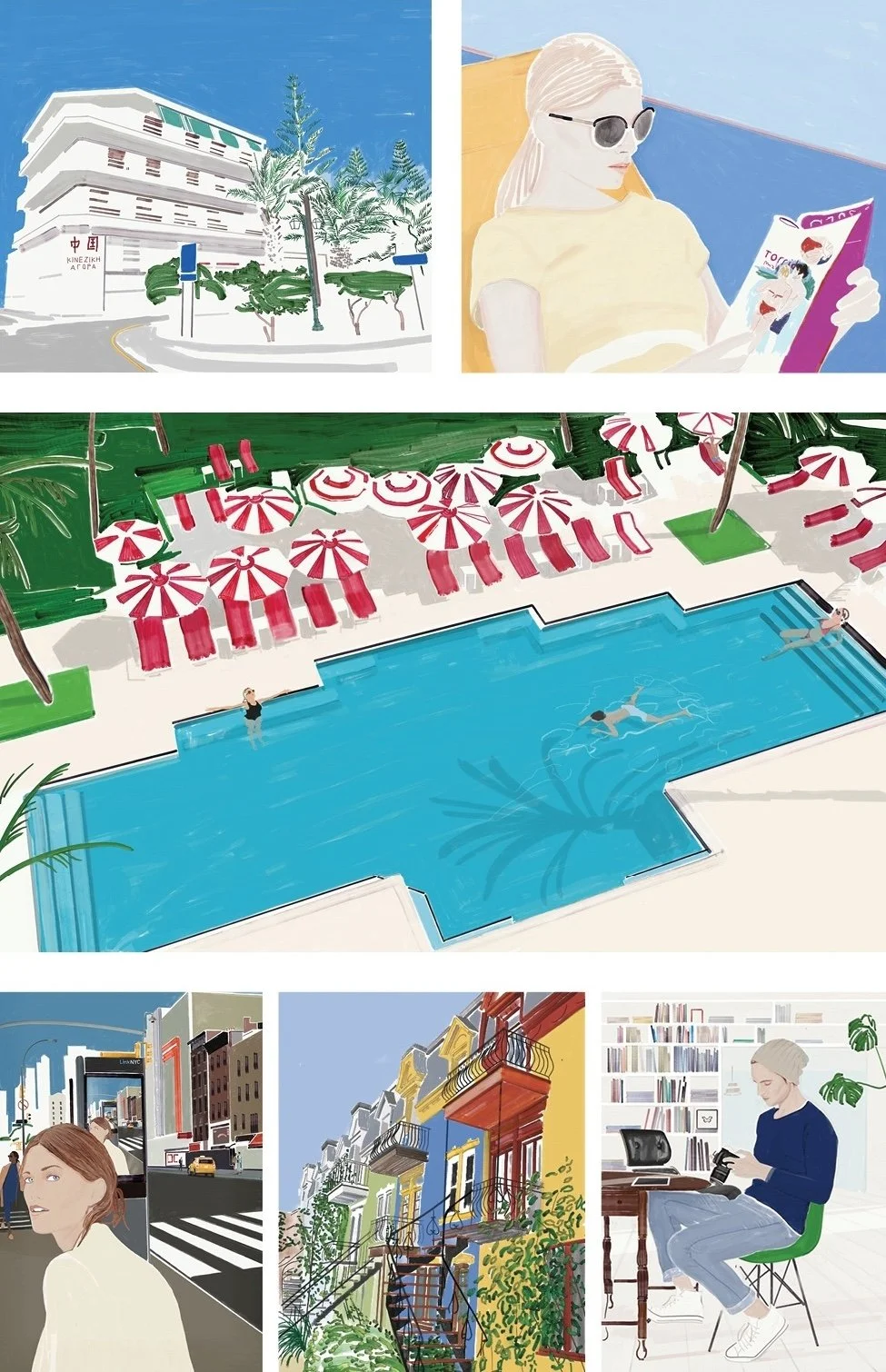
It was for a luxury hotel in Casablanca where I created 3 triptychs. The brief was inspired by three films: Mon Oncle, Singin' in the Rain and The King and The Bird. I watched the films and took screenshots each time I saw an image that inspired me, then I sent these captures to the client, adding text taken from the film. What started as pencils then became large oil paintings… the formats were as big as the deadline was short, but it was very exciting to do, I loved it!
7. How has the illustration industry shifted since you began?
It's difficult for me to say as I myself have evolved a lot. I discovered the iPad seven years ago, around the time I started working with Elle magazine, and it allowed me to respond and work much faster. I would say that what has changed more than anything is the deadlines, I get the impression that they’re only getting tighter and tighter! Also for the last 2 years there are many project requests that have not ultimately come to fruition, perhaps due to the context of everything going on in the world around us creating so much uncertainty.
8. What have some of your favorite collaborations been?
I really liked the collaboration with the Le Mont Saint Michel fashion brand which lasted a few years, and where there was a real human connection. Also my long-running collaboration with Elle magazine, and a big thank you to Geneve Doherty, the artistic director of the era! This collaboration made me evolve a lot, and it was great to see my work progress over the time we worked together.. I always enjoy any projects working with decorators, and. I love when a project calls for original artwork, I like to think of my pieces as objects that will remain in place even after the job is finished.
9. And what would your dream collaboration be?
The cover of The New Yorker of course!
10. Who, or what, are some of your greatest inspirations, and why?
My original inspiration is from paintings by artists including Matisse, Peyton, Hockney, Valloton and De Stael and includes subjects like landscapes, architecture and portraits.
11. What advice do you have for emerging illustrators? What are your three ingredients for a successful life in the arts?
Think about your style, make it recognizable and personal but also usable for projects. My main advice is to work and believe in it. There is a lot of competition out there, and many talented people, but not everyone has the faith.
12. Anything else you'd like to add?
Thank you Illustration Division Team and enjoy Spring!